
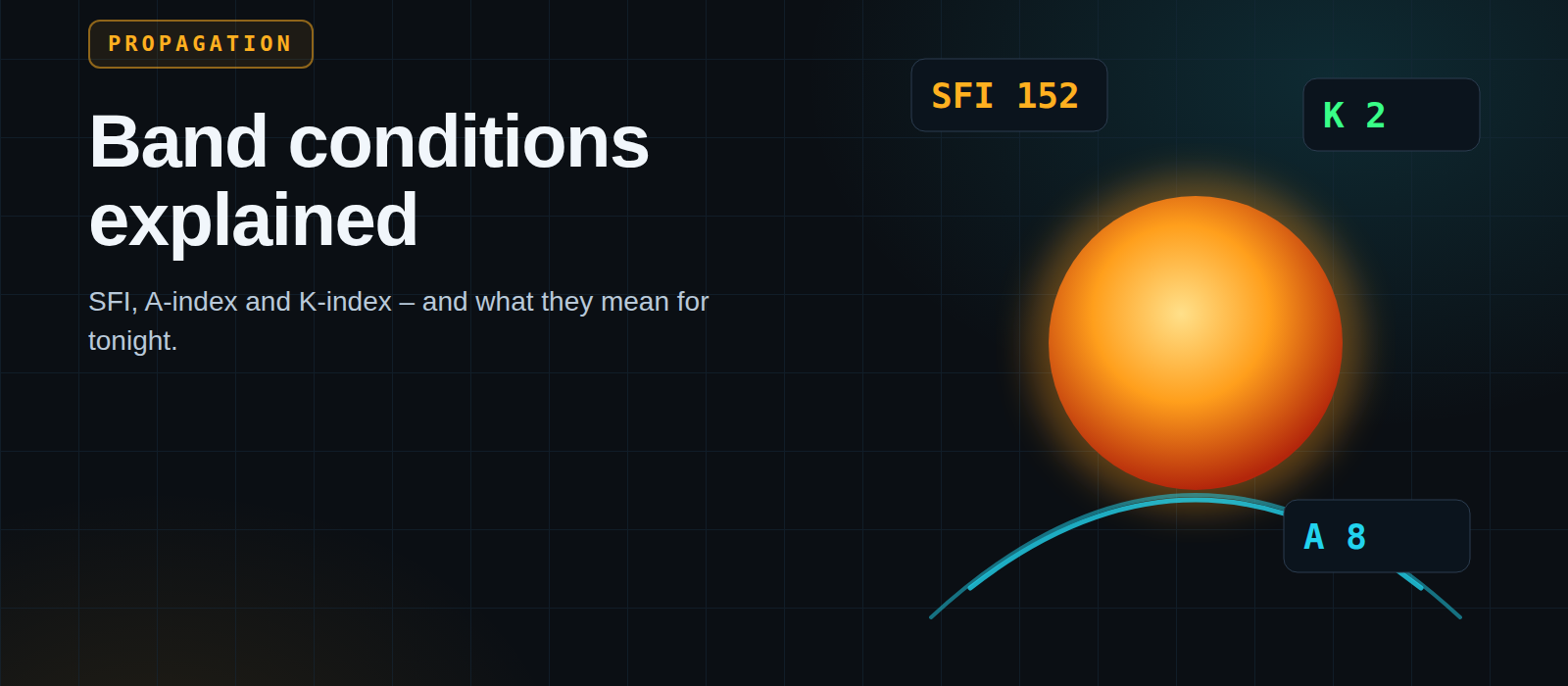
Every page on this site has a live band-conditions panel from N0NBH. It is packed with numbers, and at first glance it can look like a weather report from another planet. In a way it is – it is space weather. Here is what the most useful figures mean and how to read them before you switch on the rig.
Why the Sun matters on HF
HF signals travel long distances by bouncing off the ionosphere, layers of charged gas 60 to 400 km above our heads. The Sun keeps those layers charged. More solar activity usually means a denser ionosphere that can reflect higher frequencies, so the upper HF bands (15, 12 and 10 m) open up. Low activity means the higher bands go quiet and the lower bands (80, 40 and 20 m) do most of the work.
But the Sun can also disturb the ionosphere, and that is where the A and K indices come in.
SFI – Solar Flux Index
The SFI is the radio noise the Sun gives off at 10.7 cm (2.8 GHz). It is a good stand-in for how strongly the Sun is ionising the upper atmosphere.
| SFI | What to expect |
|---|---|
| Below about 80 | Quiet Sun. 40 and 20 m are your friends; 10 m is mostly closed for DX. |
| About 80–120 | Reasonable. 20 m works well in daylight, 15 m opens at times. |
| About 120–200 | Good. 15, 12 and 10 m come alive, especially around midday. |
| Above 200 | Excellent for the higher bands – if the A and K indices behave. |
The SN figure next to it is the sunspot number. It follows the SFI closely, so in practice you only need to watch one of them.
K-index – the last three hours
The K-index measures how disturbed the Earth’s magnetic field has been over the last three hours, on a scale from 0 to 9. A disturbed field stirs up the ionosphere and HF signals suffer, especially on paths that cross the polar regions.
| K-index | Meaning |
|---|---|
| 0–1 | Quiet – ideal conditions |
| 2–3 | Unsettled – usually still fine |
| 4 | Active – signals may be weaker and fluttery |
| 5 and above | Geomagnetic storm – HF can be poor, but look out for aurora on 6 m and 2 m |
A-index – the last 24 hours
The A-index tells the same story over a whole day, on a scale from 0 up to 400. Below about 10 is quiet, 10–30 is unsettled and anything higher points to stormy conditions. Because it is a daily average, it reacts slowly: a low K with a high A often means a storm is calming down.
Putting it together
Rule of thumb: high SFI, low K and low A = get on the higher bands. Low SFI = stick to 40 and 20 m. High K = expect a rough ride on HF, but keep an eye on VHF for aurora.
The panel also shows N0NBH’s own day/night forecast for groups of bands (Good, Fair, Poor). It is calculated from the same numbers, so it is a handy shortcut. Nothing beats listening, though – a quick look at a busy FT8 frequency or a beacon will tell you more than any index.
Grey line bonus
Around sunrise and sunset the ionosphere changes quickly, and the absorbing D-layer is thin while the reflecting F-layer is still strong. Signals along this grey line can travel remarkable distances, especially on 80 and 40 m. If you only have half an hour to operate, dawn or dusk is a great choice.
Data on this site: Paul L Herrman, N0NBH – hamqsl.com. 73!