
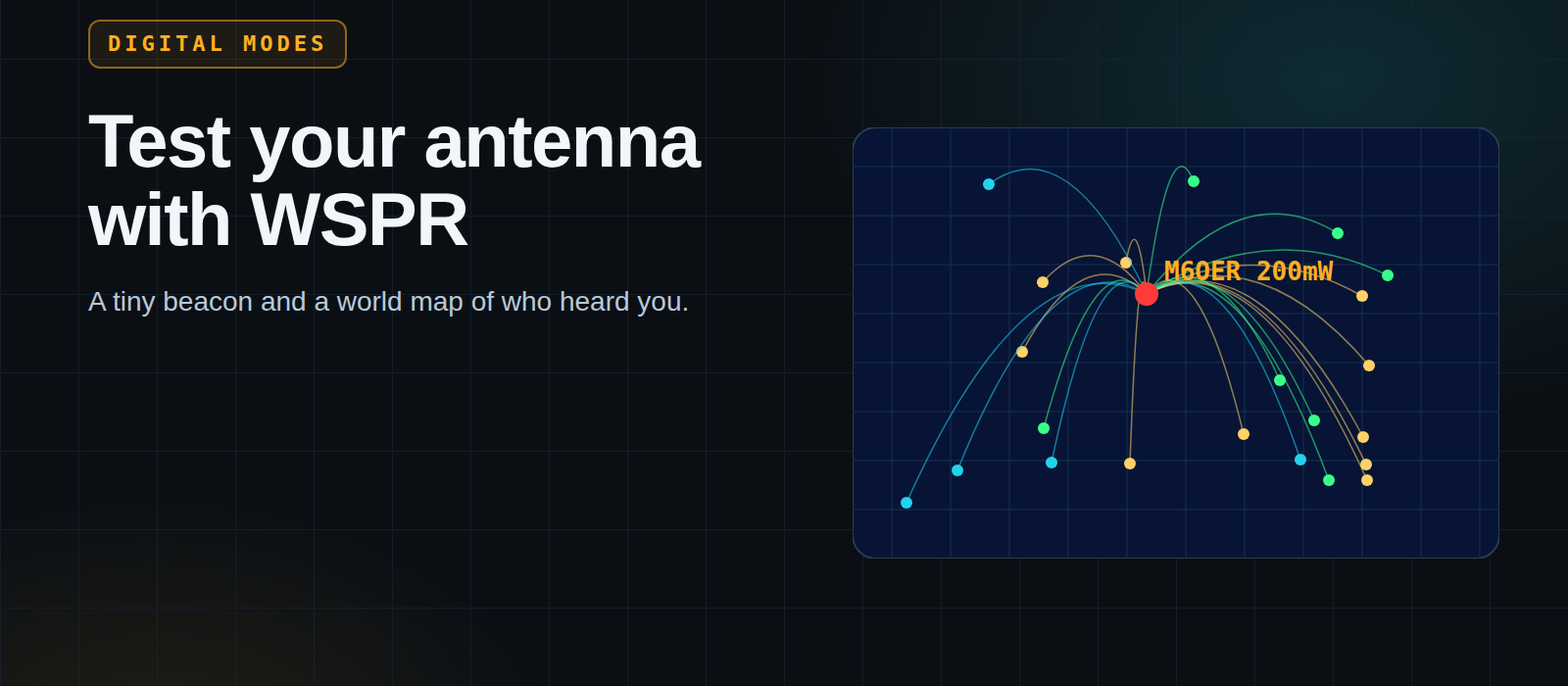
Want to know how well your new antenna really works – not what the SWR meter says, but how far your signal actually gets? Let the world tell you. WSPR (Weak Signal Propagation Reporter, pronounced “whisper”) turns your station into a tiny beacon and shows you, on a map, every station that heard it.
How it works
WSPR was written by Joe Taylor, K1JT, and is built into WSJT-X. Your station transmits a very slow, very narrow signal (about 6 Hz wide) for just under two minutes. It contains only your callsign, a four-character locator and your power level. Stations all around the world running WSPR decode it – often at signal levels far below anything you could hear – and upload the reports to wsprnet.org automatically.
Why it is great for antenna testing
- Real-world results: distance and signal-to-noise reports from hundreds of receiving stations.
- Low power: 200 mW to 1 W is typical, and still crosses oceans when the band is open.
- Fair comparisons: switch between two antennas on alternate cycles and compare the reports.
- Unattended: leave it running for an evening and look at the map in the morning.
Getting started
- In WSJT-X, choose Mode → WSPR.
- Select a band; WSJT-X sets the standard dial frequency (for example 14.0956 MHz USB on 20 m).
- Enter your callsign, locator and the power you are actually using in dBm (for example 23 dBm = 200 mW, 30 dBm = 1 W).
- Set the “Tx Pct” to around 20 % so you also spend time listening.
- Make sure your PC clock is accurate – WSPR, like FT8, depends on it.
- Press Enable Tx and leave it running.
| dBm | Power |
|---|---|
| 23 | 200 mW |
| 27 | 500 mW |
| 30 | 1 W |
| 33 | 2 W |
| 37 | 5 W |
Reading the results
On wsprnet.org, open the map and enter your callsign. Each line is a station that decoded you, with the distance and SNR. Run each antenna for the same period at the same power, on the same band, and you have a genuine side-by-side comparison. Remember that conditions change through the day, so alternating antennas is fairer than testing one in the morning and the other in the evening.
WSPR is also a brilliant propagation tool: leave a receiver running overnight and you will see exactly which bands opened to where, and when.
73 de M6OER