
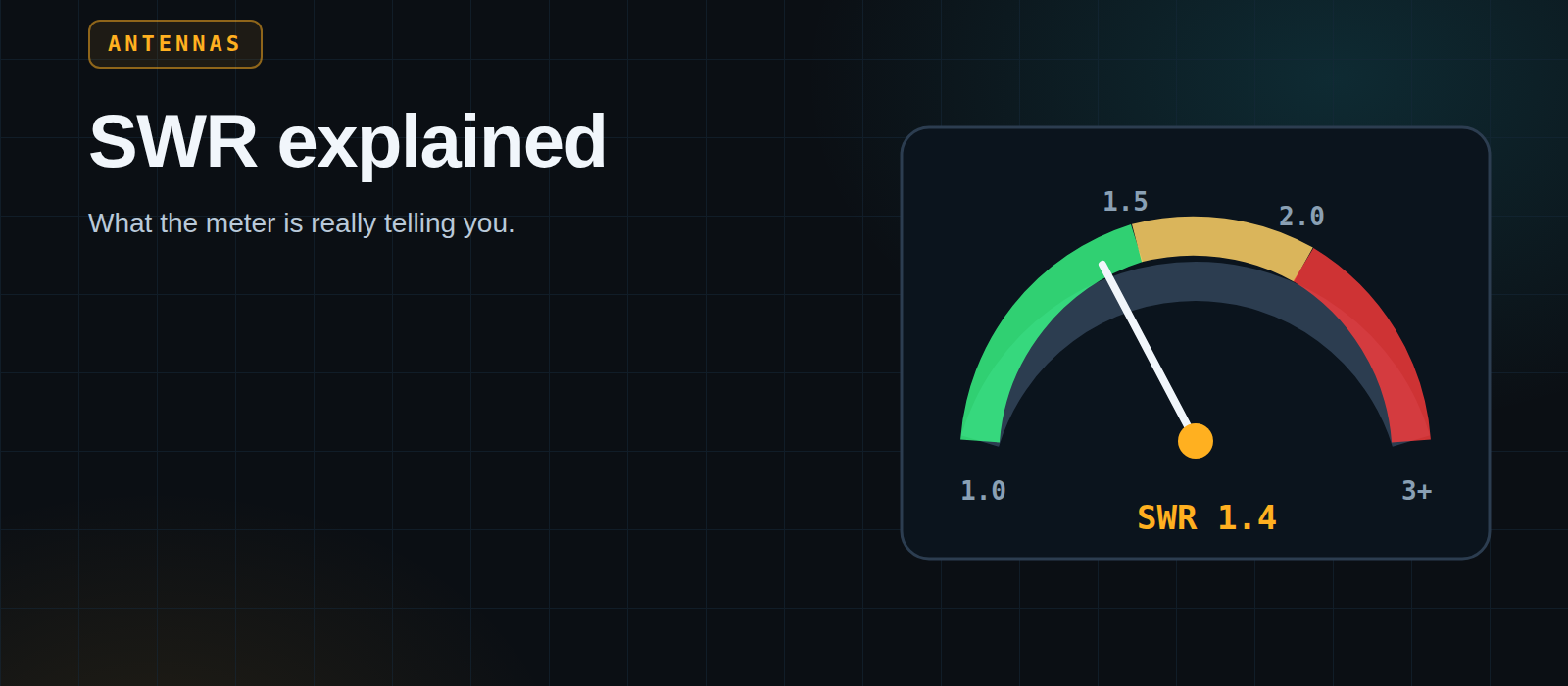
Every radio amateur spends time staring at an SWR meter. It is one of the first things we check when putting up a new antenna, and one of the most misunderstood. Here is what the number actually means and when you should worry about it.
What SWR measures
SWR stands for standing wave ratio. When the impedance of your antenna system matches the impedance of your coax and radio (usually 50 Ω), almost all of the power flows out to the antenna. When it does not match, part of the power is reflected back down the coax towards the radio. The forward and reflected waves combine into a standing wave, and SWR is a simple way of describing how big that mismatch is.
An SWR of 1:1 means a perfect match. The higher the first number, the bigger the mismatch.
How much power is reflected?
| SWR | Power reflected | In practice |
|---|---|---|
| 1.0:1 | 0 % | Perfect match |
| 1.5:1 | 4 % | Excellent – nothing to worry about |
| 2.0:1 | 11 % | Fine for most rigs; some start to reduce power |
| 3.0:1 | 25 % | Use a tuner (ATU) – most radios will fold back power |
| 5.0:1 and above | 44 % or more | Something is wrong – check the antenna and coax |
Reflected power is not simply “lost” – much of it is re-reflected at the radio end and eventually radiated – but a high SWR does increase the losses in the coax, and modern transceivers protect their output stage by reducing power when the SWR rises.
What an ATU does (and does not do)
An antenna tuner (ATU) sits between the radio and the coax and transforms whatever impedance it sees into something close to 50 Ω. Your radio is then happy and delivers full power. But the tuner does not fix the antenna: the mismatch is still there between the tuner and the antenna, and the losses in the coax still happen. A tuner is a great tool for using an antenna on bands it was not designed for – just do not expect it to turn a poor antenna into a good one.
When a perfect SWR is bad news
A long run of thin, lossy coax hides problems. Power reflected from the antenna is attenuated on its way back, so the meter in the shack reads a lovely low SWR even when the antenna itself is badly matched. A dummy load also shows 1:1 – and radiates nothing! If an antenna shows a suspiciously flat, low SWR across a very wide range of frequencies, be suspicious.
Measuring it properly
- Use low power – 5 to 10 W is plenty for an SWR check.
- Choose a clear frequency, ask if it is in use, and identify with your callsign.
- Measure at the bottom, middle and top of the band and note the readings.
- If the lowest SWR is below the band, the antenna is too long – shorten it. If it is above the band, it is too short – lengthen it.
- Better still, use an antenna analyser: it sweeps the band without transmitting and shows exactly where the antenna is resonant.
Rule of thumb: below 2:1, stop worrying and get on the air. Above 3:1, find out why before you transmit at full power.
73 de M6OER