
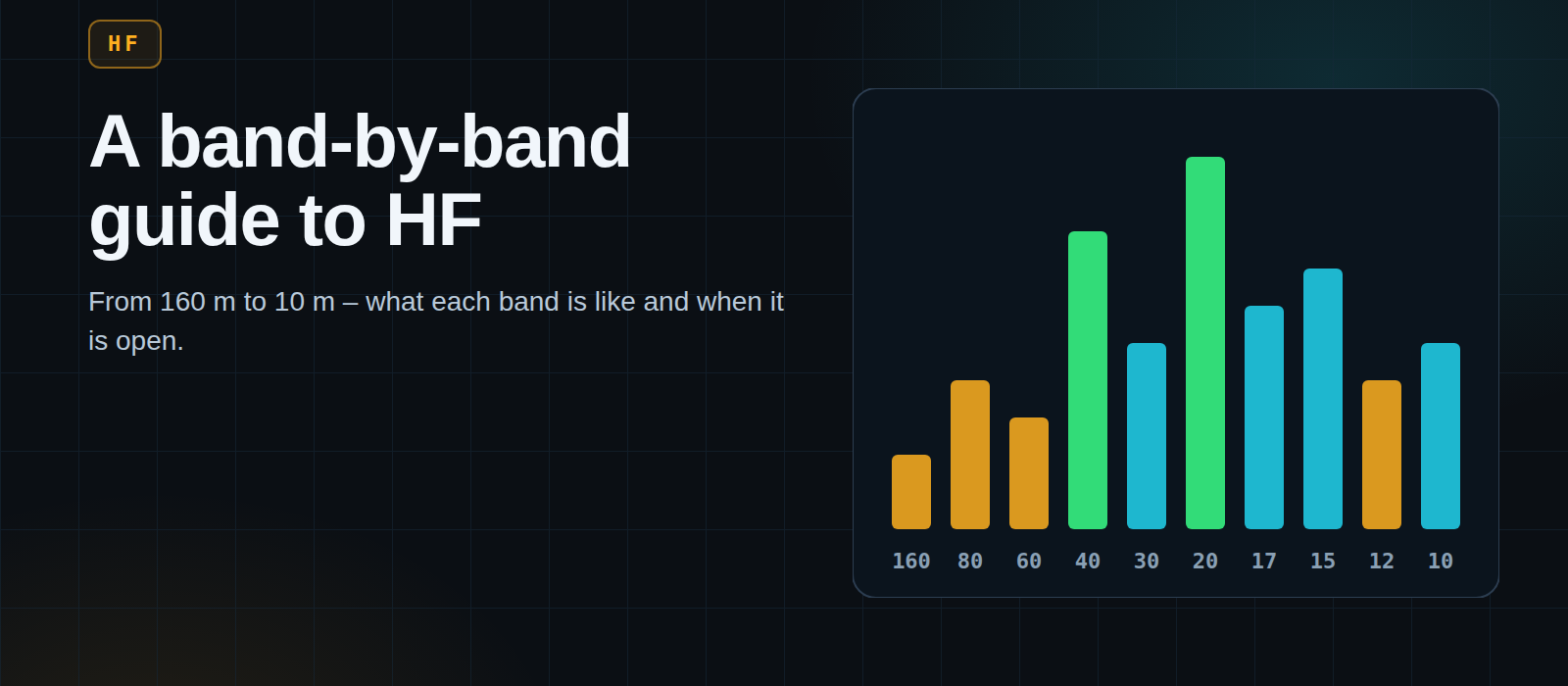
Each HF band has its own personality. Knowing which one to choose at a given time of day is half the fun – and the key to making contacts. This is a general guide; always check the current band plan and which bands and power levels your licence allows.
The low bands: 160, 80 and 60 m
160 m (1.8 MHz) – the “top band”. Mostly a night-time band; big antennas, high noise, and rare long-distance contacts that feel like real achievements around the winter solstice.
80 m (3.5 MHz) – the UK’s evening chat band. Excellent for contacts around the British Isles and Europe after dark, and the home of many nets. During the day the absorbing D-layer limits it to shorter distances.
60 m (5 MHz) – a small allocation that sits nicely between 80 and 40 m, and is very good for reliable UK and near-European contacts. Check the exact frequencies your licence allows.
The workhorses: 40 and 20 m
40 m (7 MHz) – busy day and night. During the day it covers the UK and Europe; at night it opens to the rest of the world. Great with simple wire antennas.
30 m (10.1 MHz) – a narrow band for CW and data modes only. Quiet, friendly and often open when other bands are struggling.
20 m (14 MHz) – the classic DX band. Open to somewhere in the world almost every day, even at low points of the solar cycle. If you only have time for one band, start here.
The high bands: 17, 15, 12 and 10 m
17 m (18 MHz) and 12 m (24.9 MHz) – the “WARC” bands. No contests are allowed, so they are a relaxed place for DX on busy weekends.
15 m (21 MHz) – a superb daytime DX band when the solar flux is up.
10 m (28 MHz) – feast or famine. Near solar maximum it is open worldwide with tiny power; at solar minimum it can be silent for weeks – apart from sudden sporadic-E openings in early summer that bring in strong signals from all over Europe.
Quick guide
| Band | Best time | Typical reach |
|---|---|---|
| 160 m | Night, winter | UK, Europe, occasional DX |
| 80 m | Evening, night | UK and Europe; DX at night |
| 60 m | Day and evening | UK and near Europe |
| 40 m | Day (short) / night (long) | Europe by day, worldwide at night |
| 30 m | Day and night | Europe and DX (CW/data only) |
| 20 m | Daylight, evening | Worldwide |
| 17 m | Daylight | Worldwide when conditions are good |
| 15 m | Daylight | Worldwide with good solar flux |
| 12 m / 10 m | Around midday | Worldwide near solar maximum; sporadic-E in summer |
Tip: glance at the band-conditions panel on this site, then listen to a busy FT8 frequency on two or three bands. Within a minute you will know where the action is.
73 de M6OER