
If you have ever switched on at the weekend and found the band packed wall to wall with stations calling “CQ contest”, you have met contesting. It can seem intimidating, but contests are one of the best ways to fill your log quickly – and you do not have to be a big station to take part.
What happens in a contest
Every contest has its own rules, but the idea is always the same: make as many valid contacts as possible within a set time, exchanging a short piece of information. Points come from contacts, and multipliers (such as new countries, locator squares or districts) boost the score.
The exchange
The exchange is kept short so contacts take seconds, not minutes. Typical examples:
| Contest type | Typical exchange |
|---|---|
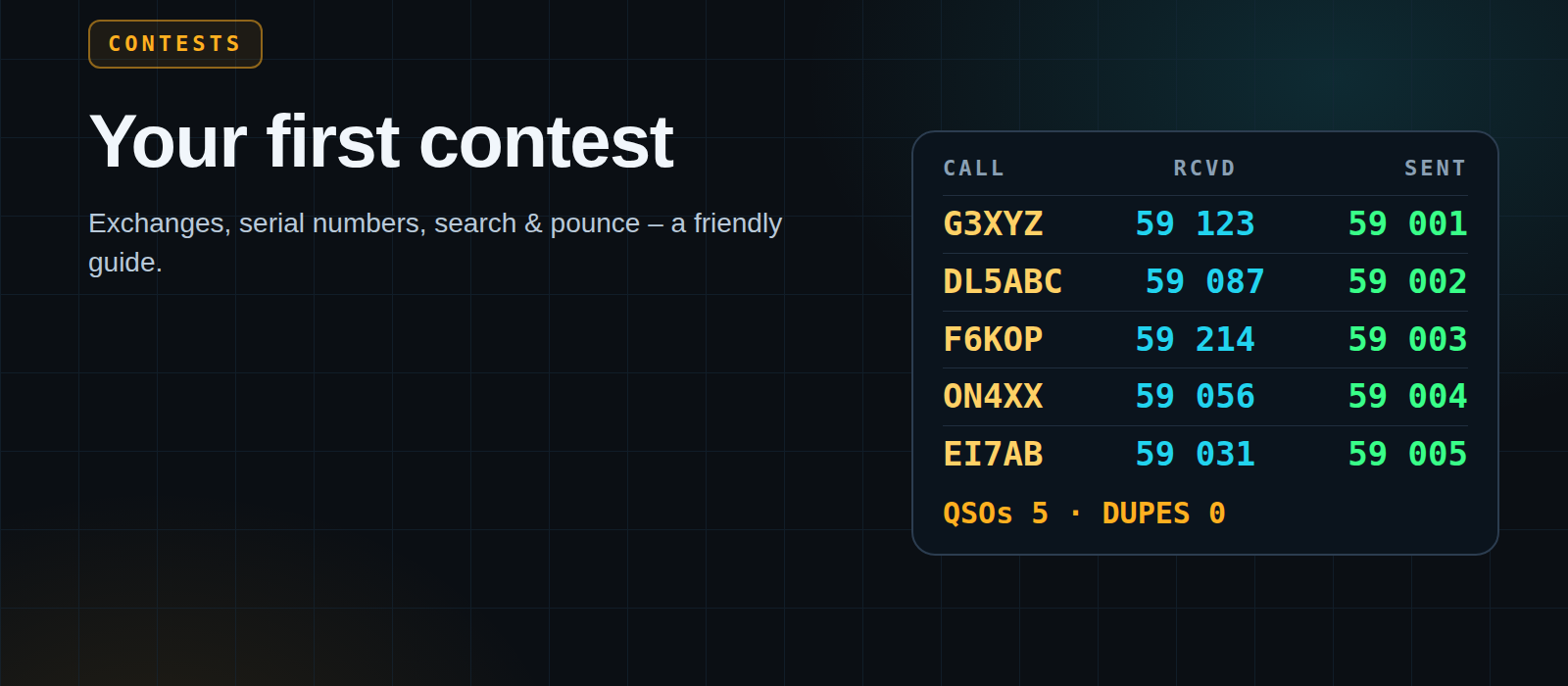
| Many HF contests | Signal report + serial number (59 001, 59 002…) |
| VHF/UHF contests | Report + serial number + six-character locator |
| Club or society contests | Report + serial number + club or district code |
Always check the rules for the specific contest – the RSGB publishes its contest calendar and rules online, with plenty of short evening contests that are ideal for a first try.
Two ways to operate
- Running: you find a clear frequency and call CQ; stations come to you. Great when you have a good signal.
- Search and pounce: you tune up the band and call stations who are running. Perfect for small stations and beginners – this is how most of us start.
A typical contest QSO (search and pounce)
Them: CQ contest, G3XYZ
You:  M6OER
Them: M6OER 59 123
You:  Thank you, 59 004
Them: Thanks, G3XYZ, QRZ?
That is it – a complete contact in under ten seconds. No need for names, weather or antennas; just a clear callsign and the exchange.
Logging
Contest logging software, such as N1MM Logger+, keeps track of serial numbers, spots duplicates (“dupes”) and calculates your score. At the end you submit your log, usually in Cabrillo format, to the organisers. Even if you only made a handful of contacts, send it in – it helps the organisers check other entrants’ logs.
Tips for your first contest
- Pick a short contest (one or two hours) rather than a full weekend.
- Listen first to learn the exchange and rhythm.
- Say your callsign once, clearly, using phonetics if conditions are poor.
- Write down what you hear, and do not be afraid to ask for a repeat.
- Have fun – nobody expects a newcomer to win.
Contests I plan to join are marked in orange on the Calendar. If you hear me, give me a point! 73